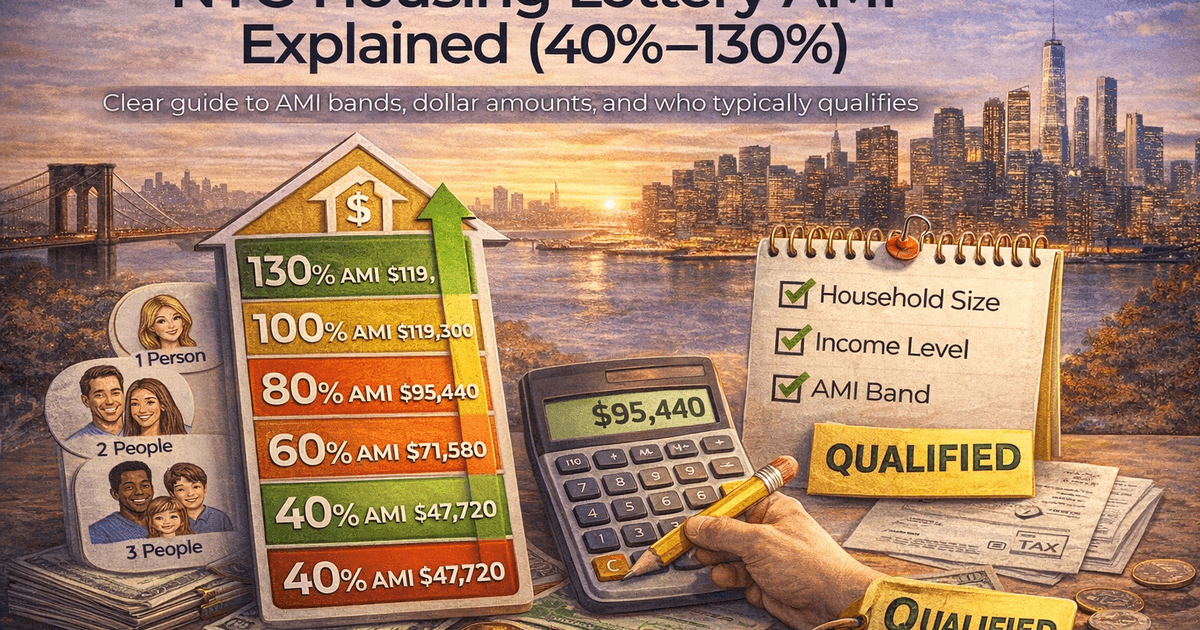
What Is AMI? NYC Income Limits Explained Simply
Introduction
If you've ever looked at an NYC Housing Connect listing, you've probably seen terms like "60% AMI" or "80% AMI" and wondered what they mean. AMI—Area Median Income—is the foundation of how New York City determines eligibility for affordable housing lotteries.
This guide breaks down AMI in simple terms, explains how income bands work, and shows you exactly how to figure out which AMI category you fall into.
What Is AMI (Area Median Income)?
AMI is the midpoint household income for a specific geographic area. In New York City's case, AMI is calculated for the entire New York-Newark metropolitan region and is set annually by the U.S. Department of Housing and Urban Development (HUD).
How AMI Works
Think of AMI as the "middle" income level:
- 50% of households earn more than the AMI
- 50% of households earn less than the AMI
for 2026, the AMI for a family of three in the NYC metro area is approximately $121,500.
NYC affordable housing programs use percentages of AMI to set income limits. For example:
- 60% AMI means your household can earn up to 60% of the area median income
- 80% AMI means your household can earn up to 80% of the area median income
NYC AMI Income Bands Explained
NYC housing lotteries target different AMI bands depending on the funding source and building program. Here are the most common bands:
30% AMI (Extremely Low Income)
Target Population: Households with very limited income, often receiving public assistance.
2026 Income Limits (Approximate):
- 1 person: $28,350
- 2 people: $32,400
- 3 people: $36,450
- 4 people: $40,450
Typical Rent: $700–$1,000/month
40% AMI (Very Low Income)
Target Population: Working households with limited income.
2026 Income Limits (Approximate):
- 1 person: $37,800
- 2 people: $43,200
- 3 people: $48,600
- 4 people: $53,950
Typical Rent: $950–$1,350/month
50% AMI (Low Income)
Target Population: Low-wage workers, service industry employees.
2026 Income Limits (Approximate):
- 1 person: $47,250
- 2 people: $54,000
- 3 people: $60,750
- 4 people: $67,450
Typical Rent: $1,180–$1,680/month
60% AMI (Low Income – Most Common)
Target Population: Entry-level professionals, public sector workers, families with multiple earners.
2026 Income Limits (Approximate):
- 1 person: $56,700
- 2 people: $64,800
- 3 people: $72,900
- 4 people: $80,900
Typical Rent: $1,420–$2,020/month
Note: 60% AMI is the most common income band for NYC housing lotteries.
80% AMI (Moderate Income)
Target Population: Middle-income working families, teachers, nurses, city employees.
2026 Income Limits (Approximate):
- 1 person: $75,600
- 2 people: $86,400
- 3 people: $97,200
- 4 people: $107,900
Typical Rent: $1,890–$2,690/month
100% AMI (Moderate-Middle Income)
Target Population: Dual-income households, established professionals.
2026 Income Limits (Approximate):
- 1 person: $94,500
- 2 people: $108,000
- 3 people: $121,500
- 4 people: $134,850
Typical Rent: $2,360–$3,360/month
130% AMI (Middle Income)
Target Population: Higher-earning professionals who still need affordable options.
2026 Income Limits (Approximate):
- 1 person: $122,850
- 2 people: $140,400
- 3 people: $157,950
- 4 people: $175,305
Typical Rent: $3,070–$4,370/month
How to Calculate Your AMI Level
Step 1: Calculate Your Household's Gross Annual Income
Add up all income sources for every adult in your household:
- Wages and salaries (before taxes)
- Self-employment income
- Social Security benefits
- Unemployment benefits
- Child support and alimony
- Pension and retirement income
- Investment income
Example: You earn $45,000/year, and your partner earns $30,000/year. Your combined gross household income is $75,000/year.
Step 2: Determine Your Household Size
Count everyone who will live in the unit:
- Adults
- Children
- Dependents
Example: You, your partner, and one child = 3 people.
Step 3: Find Your AMI Percentage
Use the NYC AMI chart (updated annually on NYC Housing Connect) or use the NYC AMI Calculator at nychousinglottery.com/ami-calculator.
Example Calculation:
- Household income: $75,000
- Household size: 3 people
- 60% AMI limit for 3 people: $72,900
- 80% AMI limit for 3 people: $97,200
Result: Your household is above 60% AMI but below 80% AMI, so you qualify for lotteries targeting 80% AMI or higher.
How Income Band Affects Housing Lottery Eligibility
Minimum and Maximum Income Requirements
Most NYC housing lotteries set both a minimum and maximum income limit.
Example Lottery:
- Unit: 2-bedroom in Brooklyn
- Rent: $1,800/month
- Income requirement: 60% AMI
For a household of three:
- Minimum income: ~$64,800 (to afford the rent)
- Maximum income: $72,900 (60% AMI cap)
If your household earns $80,000, you're over the limit and won't qualify—even if you can afford the rent.
Why AMI Limits Exist
AMI limits ensure that affordable housing units go to households who genuinely need them. Without these caps, higher earners would dominate the lottery, leaving lower-income families with no options.
Common AMI Misconceptions
Myth 1: "AMI is the same every year."
False. HUD updates AMI figures annually to account for inflation and wage growth. Always check the current year's limits.
Myth 2: "I can use my net income (after taxes) to qualify."
False. AMI calculations use gross income (before taxes and deductions). Do not subtract taxes, retirement contributions, or health insurance premiums.
Myth 3: "If I'm close to the limit, I should round down."
False. Misreporting income is grounds for immediate disqualification. Always report your full, accurate gross income.
Myth 4: "Once my income is verified, I don't need to update it."
False. If your income changes significantly between application and lease signing, you must report it. Failure to do so can result in lease denial.
AMI and Rent Calculations
The 30% Rule
NYC housing programs typically set rent at 30% of the household's gross income.
Example:
- Household income: $60,000/year
- Monthly gross income: $5,000
- Maximum rent: $1,500/month (30% of $5,000)
This ensures that rent remains affordable relative to income.
Rent Burden in NYC
For many New Yorkers, rent consumes 40%–50% of gross income. Affordable housing programs aim to reduce this burden to the more sustainable 30% threshold.
How to Use the NYC AMI Calculator
The NYC AMI Calculator at nychousinglottery.com/ami-calculator allows you to:
- Enter your household size
- Enter your gross annual income
- Instantly see which AMI band you fall into
- View which housing lotteries you're eligible for
Pro Tip: Run the calculator before browsing Housing Connect listings to save time and avoid applying to lotteries you don't qualify for.
AMI by Borough: Does Location Matter?
Single AMI for All Five Boroughs
Unlike some cities, NYC uses a single AMI figure across all five boroughs—Bronx, Brooklyn, Manhattan, Queens, and Staten Island.
Why This Matters:
- A household earning $70,000 qualifies for 60% AMI housing in the Bronx the same way they would in Manhattan.
- However, rent amounts vary by borough based on construction costs and neighborhood.
Rent Differences by Borough
Even though AMI limits are the same, actual rents differ:
- Manhattan: Typically higher rents ($1,800–$2,500 for 60% AMI units)
- Brooklyn: Moderate to high rents ($1,500–$2,200)
- Queens: Moderate rents ($1,400–$2,000)
- Bronx: Lower rents ($1,200–$1,800)
- Staten Island: Lower to moderate rents ($1,300–$1,900)
Frequently Asked Questions
What AMI level do I fall under?
Use the NYC AMI Calculator or check the HUD income limits chart. Divide your gross household income by the AMI limit for your household size to find your percentage.
What income qualifies for NYC housing lottery?
It depends on the specific lottery. Most target 60% AMI, but lotteries range from 30% AMI (extremely low income) to 130% AMI (middle income).
Does NYC AMI include household income from all adults?
Yes. All adults in the household must report their income, including wages, benefits, and other sources.
Can I apply if I'm slightly over the AMI limit?
No. Even if you're $1 over the maximum income limit, you will be disqualified.
How is AMI calculated for NYC?
AMI is set by HUD based on median household income data for the New York-Newark metropolitan statistical area.
What is the difference between AMI and FPL (Federal Poverty Level)?
AMI is based on median regional income, while FPL is a national measure of poverty. NYC affordable housing uses AMI, not FPL.
Conclusion
Understanding AMI is essential for navigating the NYC housing lottery. By knowing your AMI band, you can target lotteries you're eligible for and avoid wasting time on applications that will be automatically rejected.
Use the NYC AMI Calculator to determine your eligibility, and consider setting up automated alerts so you're notified as soon as new lotteries matching your income band and preferences open.
Internal Links: