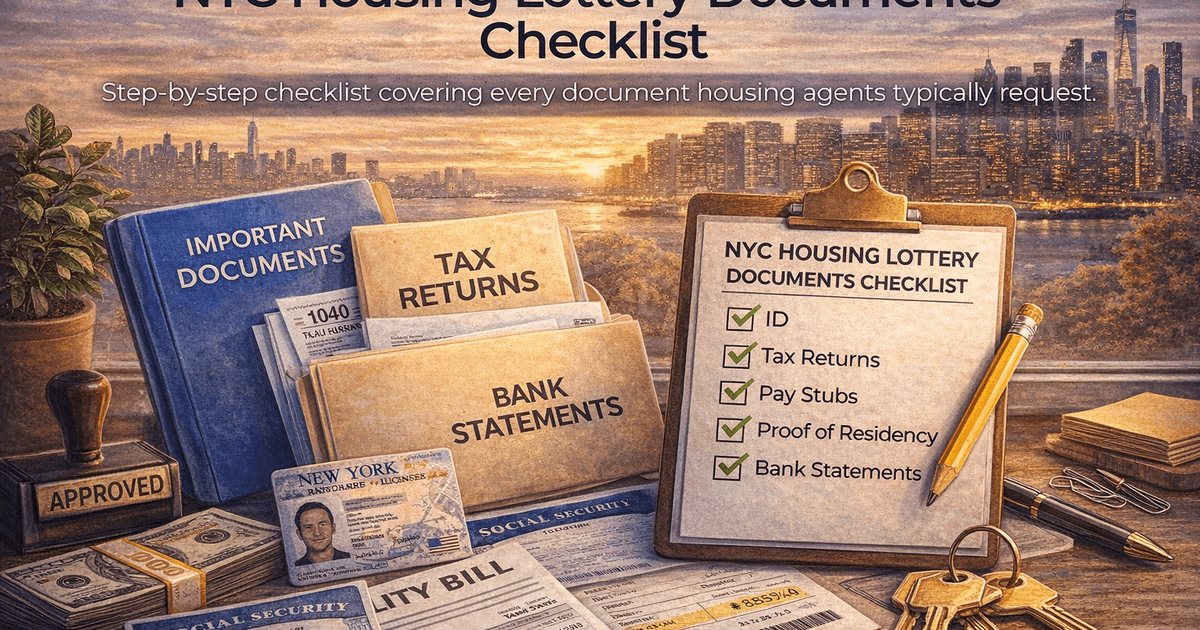
NYC Housing Lottery Required Documents Checklist (2026)
Introduction
Getting selected in the NYC Housing Lottery is just the first step. Once you receive a log number and are contacted by HPD or the building's managing agent, you'll need to submit a comprehensive set of documents to verify your eligibility.
Missing or incomplete documentation is the #1 reason applicants are disqualified after lottery selection. This guide provides a complete, up-to-date checklist of every document you'll need for the NYC housing lottery in 2026—plus tips on how to organize and submit them correctly.
Why Document Verification Matters
The Two-Stage Process
Stage 1: Lottery Selection
- Your application is randomly selected
- You receive a log number
Stage 2: Document Verification
- You must prove income, household size, residency, and identity
- HPD cross-references your documents with IRS, SSA, and credit reports
- Incomplete or inaccurate documentation = disqualification
Important: Being selected in the lottery does not guarantee housing. You must pass document verification to proceed to the interview and lease signing.
Complete NYC Housing Lottery Document Checklist
Category 1: Income Verification
Income verification is the most critical part of the process. You must prove that your household income falls within the lottery's AMI range.
Federal Tax Returns (Required)
What to Submit:
- Last 2 years of complete federal tax returns (Form 1040)
- Include all schedules (Schedule C for self-employment, Schedule E for rental income, etc.)
Where to Get It:
- IRS website (irs.gov) – request free transcripts
- Tax software (TurboTax, H&R Block, etc.)
- Your tax preparer
Pro Tips:
- Submit copies, not originals
- Make sure all pages are included (W-2s, 1099s, etc.)
- If you didn't file taxes, you'll need a notarized letter explaining why
Pay Stubs (Required)
What to Submit:
- Last 4 consecutive pay stubs (most recent)
- Must show gross income, deductions, and year-to-date totals
Requirements:
- Stubs must be recent (within 60 days of submission)
- Must include employer name, your name, and pay period dates
- If paid bi-weekly, submit 4 stubs; if paid monthly, submit 4 months
Self-Employed?
- Provide last 2 years of tax returns with Schedule C
- Bank statements showing deposits
- Profit/loss statement or ledger
Employer Verification Letter (Required)
What to Submit:
- Letter from your employer on company letterhead
- Must state:
- Your name and position
- Hire date
- Current salary or hourly wage
- Full-time or part-time status
- Whether employment is permanent or temporary
Format:
- Signed by HR or supervisor
- Dated within 30 days of submission
Self-Employed?
- Provide a notarized self-employment affidavit
- Include business license or EIN (if applicable)
Proof of Additional Income (If Applicable)
Social Security Income:
- SSA benefit award letter
- Bank statements showing deposits
Child Support or Alimony:
- Court order or separation agreement
- Last 6 months of bank statements showing deposits
- Notarized letter from payer (if informal arrangement)
Unemployment Benefits:
- NYS Department of Labor benefit statement
- Bank statements showing deposits
Pension or Retirement Income:
- Pension award letter
- 1099-R form
- Bank statements
Rental Income:
- Lease agreement for property you own
- Bank statements showing rent deposits
- Schedule E from tax return
Investment Income:
- 1099-DIV or 1099-INT forms
- Brokerage statements
Category 2: Identity Documents
Government-Issued Photo ID (Required)
Acceptable IDs:
- Driver's license (current or expired within 1 year)
- State-issued ID card
- Passport
- Military ID
- Permanent resident card (green card)
Requirements:
- Must show full name and date of birth
- Submit clear, legible copy
- Expired IDs older than 1 year are not accepted
Social Security Cards (Required)
What to Submit:
- Social Security cards for ALL household members (adults and children)
Lost Your Card?
- Request a replacement at ssa.gov or visit an SSA office
- Processing time: 10–14 days
Pro Tip: Don't wait until you're contacted by HPD. Order replacement cards as soon as you apply to the lottery.
Category 3: Proof of NYC Residency
You must prove you currently live or work in New York City.
Acceptable Proof of Residency (Submit 2 Documents)
Option 1: Current Lease or Rental Agreement
- Must show your name and NYC address
- Signed by landlord
Option 2: Utility Bills
- Electric, gas, or water bill
- Must be in your name
- Dated within 60 days
Option 3: Bank Statements
- Last 2 months of statements
- Must show your name and NYC address
Option 4: NYC Employer Letter
- Letter from employer confirming you work in NYC
- Include workplace address
Option 5: IDNYC Card
- Valid NYC municipal ID
Option 6: Voter Registration
- NYC voter registration card
Living with Family or Friends?
- Notarized letter from the person you live with
- Copy of their lease or utility bill
- Your own bank statement or government mail showing the address
Category 4: Household Composition Documents
You must prove the size and makeup of your household.
Birth Certificates (Required for Children)
What to Submit:
- Birth certificates for all children in the household
- Must show parent names
Where to Get It:
- NYC Vital Records (if born in NYC)
- State vital records office (if born elsewhere)
Marriage Certificate or Domestic Partnership (If Applicable)
What to Submit:
- Marriage certificate (if married)
- Domestic partnership registration (if applicable)
Where to Get It:
- NYC City Clerk's office
- State vital records office
Custody Documents (If Applicable)
What to Submit:
- Court order granting custody
- Separation agreement outlining custody arrangement
Why It Matters:
- HPD will only count children in your household if you have legal custody or the child lives with you full-time
School Enrollment (For Children)
What to Submit:
- School enrollment letter or report card
- Must show child's name and school address
Why It Matters:
- Proves children live with you (especially important in shared custody situations)
Category 5: Financial Documents
Bank Statements (Required)
What to Submit:
- Last 2 months of statements for ALL accounts (checking, savings, investment accounts)
- Must show account holder name, account number, and balance
Why It Matters:
- HPD checks your assets to ensure you don't exceed asset limits (typically $100,000 for most lotteries)
Pro Tip: Close or don't disclose accounts with large balances if you're near the asset limit (consult a housing counselor first).
Credit Report (Required)
What to Submit:
- Full credit report from all three bureaus (Experian, Equifax, TransUnion)
- Or tri-merge credit report
Where to Get It:
- AnnualCreditReport.com (free once per year)
- Credit monitoring services (Credit Karma, etc.)
Why It Matters:
- HPD evaluates your creditworthiness and rental history
- Poor credit isn't always disqualifying, but you may need to provide explanations
Asset Documentation (If Applicable)
What to Submit:
- Vehicle titles (if you own a car)
- Property deeds (if you own real estate)
- Investment account statements (401k, IRA, stocks, bonds)
- Life insurance policies with cash value
Why It Matters:
- Most lotteries have asset limits. Total assets (excluding retirement accounts) usually can't exceed $100,000.
Category 6: Special Circumstances
Previous Eviction or Rental Issues
What to Submit:
- Court documents explaining the eviction
- Notarized letter providing context (e.g., medical emergency, job loss)
- Proof of rent payments since the eviction
Why It Matters:
- Previous evictions don't always disqualify you, but you must explain the circumstances
Outstanding Debt or Judgments
What to Submit:
- Court documents
- Payment plan agreements
- Proof of payments
Disability Documentation (If Applicable)
What to Submit:
- SSA disability award letter
- Doctor's letter outlining disability and accommodation needs
Why It Matters:
- Qualifies you for accessible units or priority placement
Military Service (If Applicable)
What to Submit:
- DD-214 (discharge papers)
Why It Matters:
- Some lotteries offer preference to veterans
How to Organize Your Documents
Step 1: Create a Dedicated Folder
Physical Folder:
- Use a binder with labeled dividers for each category
Digital Folder:
- Scan all documents to PDF
- Name files clearly (e.g., "2024_Tax_Return.pdf", "Pay_Stubs_Jan_Apr_2025.pdf")
- Store in cloud storage (Google Drive, Dropbox) for easy access
Step 2: Make Copies
Never submit original documents. Always submit copies and keep originals in a safe place.
Step 3: Label Everything
Write your name, log number, and the lottery name on every document.
Step 4: Create a Checklist
Use this guide as a checklist. Check off each item as you gather it.
Submission Process
How Documents Are Submitted
Option 1: Email (Preferred)
- Scan documents to PDF
- Email to the address provided by HPD or the managing agent
Option 2: Mail
- Send copies via certified mail with tracking
- Keep proof of mailing
Option 3: In-Person Drop-Off
- Deliver to the building's management office or HPD office
- Get a receipt
Timelines and Deadlines
When You'll Be Contacted:
- 6–18 months after receiving your log number (varies by lottery)
How Long You Have to Submit:
- Typically 10–14 days from the date of the request
Pro Tip: Check your email and postal mail daily. Missing the deadline can cost you your spot.
Common Document Mistakes to Avoid
Mistake 1: Missing Pages
Problem: Submitting incomplete tax returns or pay stubs.
Fix: Double-check that all pages are included. Tax returns should include Form 1040, all schedules, and W-2s/1099s.
Mistake 2: Outdated Documents
Problem: Submitting pay stubs or utility bills older than 60 days.
Fix: Use the most recent documents available.
Mistake 3: Illegible Copies
Problem: Submitting blurry, dark, or cut-off scans.
Fix: Use a scanner (not a phone camera) and ensure all text is readable.
Mistake 4: Not Reporting All Income
Problem: Omitting freelance work, side gigs, or cash income.
Fix: Report all income. HPD will cross-check with IRS records.
Mistake 5: Forgetting Household Members
Problem: Not including birth certificates or Social Security cards for children.
Fix: Submit documents for every household member, including infants.
Mistake 6: Waiting Too Long to Gather Documents
Problem: Scrambling to request tax transcripts or replacement Social Security cards after being contacted by HPD.
Fix: Gather documents as soon as you apply to the lottery. Don't wait for contact.
What Happens After You Submit Documents
Step 1: Document Review
HPD or the managing agent reviews your documents for completeness and accuracy.
Timeline: 4–8 weeks
Step 2: Verification
HPD cross-references your documents with:
- IRS tax records
- Social Security Administration data
- Credit bureaus
- Employer verification
Step 3: Interview
If your documents are approved, you'll be scheduled for an in-person or virtual interview.
What to Expect:
- Review of your application
- Questions about household composition and income
- Discussion of lease terms
Step 4: Final Approval
If you pass the interview, you'll receive a lease offer.
Timeline: 1–3 months after interview
Frequently Asked Questions
What documents do I need for the NYC housing lottery?
You need tax returns (2 years), pay stubs (4 recent), employer letter, government ID, Social Security cards, proof of NYC residency, birth certificates for children, and bank statements.
How long do I have to submit documents after being contacted?
Typically 10–14 days. Check the request letter for the exact deadline.
Can I submit documents before being contacted?
No. Wait until HPD or the managing agent requests documents. Unsolicited submissions are not accepted.
What if I don't have 2 years of tax returns?
Provide a notarized letter explaining why (e.g., first-time filer, student, recent immigrant). Include other income proof like bank statements and employer letters.
Do I need original documents or copies?
Copies are acceptable. Never mail original documents.
What if my documents are in another language?
Provide certified English translations along with the original documents.
Can I submit documents via email?
Yes, if the managing agent or HPD provides an email address. Scan documents to PDF and send as attachments.
Conclusion
Document verification is the most critical stage of the NYC housing lottery process. By organizing your documents in advance, submitting complete and accurate paperwork, and responding promptly to HPD requests, you significantly increase your chances of final approval.
Use this checklist to prepare early—don't wait until you're contacted. The better organized you are, the smoother the process will be.
Internal Links: