Editorial insights

Housing Connect vs. Vouchers

Complete comparison of NYC Housing Connect lottery system vs. voucher programs like CityFHEPS and Section 8 in 2026. Learn key differences, eligibility requirements, application processes, and which affordable housing option is best for your situation.

Updated January 26, 2026

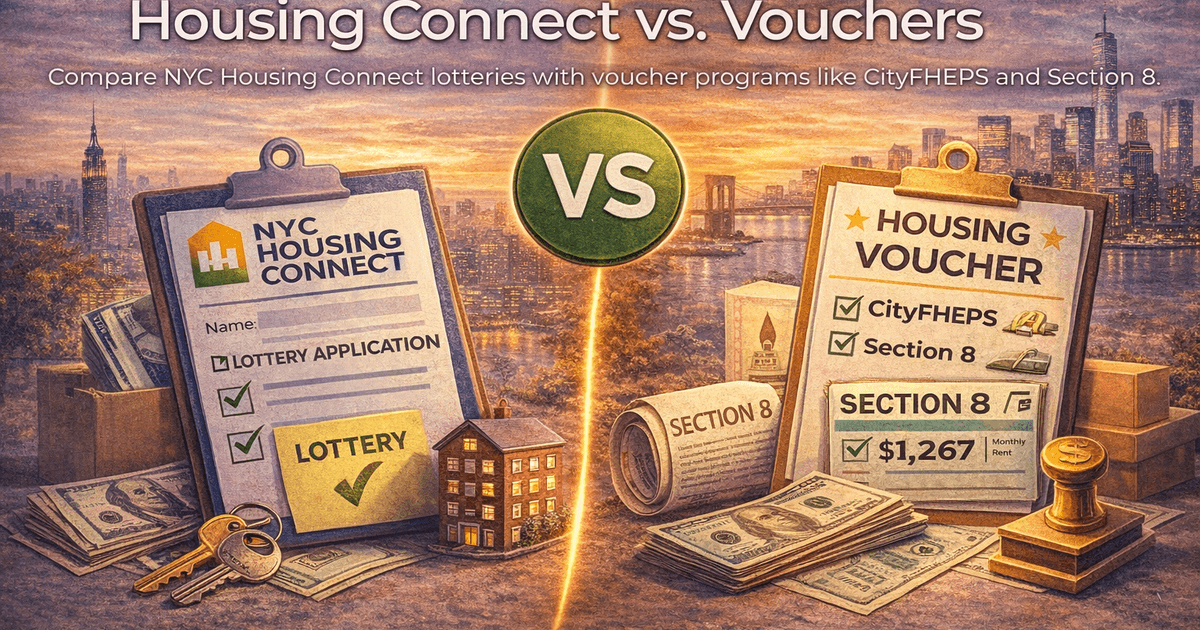
Housing Connect vs. Vouchers | NYC Affordable Housing Options 2026 - Comprehensive guide to NYC Housing Lottery with visual infographic showing key information, timelines, and strategies

Introduction

NYC offers two main pathways to affordable housing: Housing Connect lotteries and rental voucher programs (Section 8, CityFHEPS, FHEPS). Many applicants don't understand the difference and miss opportunities by only pursuing one path.

This guide explains how lotteries and vouchers differ, which option fits your income and situation, and why pursuing both simultaneously dramatically improves your chances of securing affordable housing.

The key insight: These programs aren't competing—they're complementary. Applying to Housing Connect lotteries AND voucher programs maximizes your options.

What Is NYC Housing Connect?

NYC Housing Connect is the portal for applying to affordable housing lotteries. These lotteries allocate rent-stabilized apartments in specific buildings at below-market rates.

Key characteristics: You apply to individual building lotteries, each with a specific address, unit mix, and AMI target. If selected, you move into that specific building.

Rent is fixed based on AMI band: A 60% AMI unit might rent for $1,400/month regardless of market conditions.

Long-term stability: Once you move in, your rent is stabilized with minimal annual increases (typically 2-3%). You can stay indefinitely as long as your income remains within limits.

Timeline: 1.5-3 years from application to move-in is typical.

No portability: If you win a lottery for a building in Crown Heights, you must live in that building. You can't transfer your lottery win to a different building or neighborhood.

What Are Housing Vouchers (Section 8, CityFHEPS, FHEPS)?

Housing vouchers are rental assistance programs where the government pays a portion of your rent directly to your landlord. You find your own apartment on the private market, and the voucher covers part (or all) of the rent.

Section 8 (Housing Choice Voucher): Federal program managed by NYCHA. Pays the difference between 30% of your income and the fair market rent. You pay 30%, the voucher pays the rest.

CityFHEPS (City Fighting Homelessness & Eviction Prevention Supplement): NYC program for households at risk of homelessness or currently in shelter. Covers rent up to local limits based on household size.

FHEPS (Family Homelessness & Eviction Prevention Supplement): NYC program specifically for families with children in shelter or at imminent risk of homelessness.

Timeline: Section 8 waiting lists are often closed or have multi-year waits. CityFHEPS and FHEPS can be faster (6-12 months) if you meet eligibility criteria.

Portability: With a voucher, you can live anywhere a landlord accepts it. You're not tied to a specific building or development.

Key Differences: Housing Connect vs. Vouchers

Funding source: Housing Connect units are funded by developers using tax credits and city subsidies. Vouchers are funded by federal (Section 8) or city (CityFHEPS/FHEPS) budgets.

Unit selection: Housing Connect assigns you a specific unit in a specific building. Vouchers let you find your own apartment anywhere in NYC (or beyond, with portability).

Landlord acceptance: Housing Connect apartments are guaranteed—if you're selected, you get the unit. With vouchers, you must find a landlord willing to accept the voucher, which can be difficult.

Rent calculation: Housing Connect units have fixed rents based on AMI. Vouchers calculate rent as 30% of your income, with the government paying the difference.

Timeline: Housing Connect takes 1.5-3 years. Section 8 takes years (if waitlists are even open). CityFHEPS/FHEPS can be faster (6-12 months) but require homelessness risk.

Income limits: Housing Connect has specific AMI bands (40%, 60%, 80%, etc.). Section 8 targets 50% AMI and below. CityFHEPS/FHEPS have flexible limits but prioritize extremely low-income households.

Responsibility: Housing Connect tenants deal directly with building management. Voucher holders deal with private landlords plus NYCHA or HRA for voucher administration.

Portability: Housing Connect units are not portable—you must live in the assigned building. Section 8 vouchers are portable nationwide (with some restrictions). CityFHEPS/FHEPS are NYC-only but allow you to move within the city.

Which Option Fits Your Income?

Under 30% AMI (Extremely Low Income): Prioritize Section 8 and CityFHEPS/FHEPS. You likely qualify for vouchers, which provide deeper subsidies than most Housing Connect lotteries. Also apply to 30-40% AMI Housing Connect lotteries as backup.

30-50% AMI (Very Low Income): Pursue both. You qualify for Section 8, CityFHEPS/FHEPS, and many Housing Connect lotteries (40%, 50%, 60% AMI). Having options in both categories dramatically improves your odds.

50-60% AMI (Low Income): Focus on Housing Connect 60% AMI lotteries, which are plentiful. You may still qualify for Section 8 depending on household size, so keep that option open. CityFHEPS/FHEPS is unlikely unless you're at homelessness risk.

60-80% AMI (Moderate Income): Housing Connect is your primary option. Section 8 income limits typically exclude households above 50-60% AMI. Focus on applying to 70%, 80%, and 100% AMI lotteries.

80%+ AMI (Above Moderate Income): Housing Connect 80-130% AMI lotteries are your only option. Voucher programs don't serve this income bracket.

At homelessness risk: Regardless of income, prioritize CityFHEPS and FHEPS. These programs are designed for households in shelter or facing imminent eviction and can provide assistance within 6-12 months.

Example scenario: A single parent earning $45,000 (about 48% AMI for 2 people) should apply to Section 8 (if waitlist opens), apply for CityFHEPS (if at homelessness risk), AND apply to 50%, 60%, and 70% AMI Housing Connect lotteries.

Stacking Strategies: Why Pursue Both Simultaneously

Reason 1: Timelines are unpredictable. You might win a Housing Connect lottery in 18 months or wait 3+ years. A Section 8 voucher could take 5-10 years—or the waitlist might open unexpectedly. Having multiple applications active means you'll take whichever comes first.

Reason 2: Different odds. Housing Connect lotteries have sub-1% odds per lottery, but applying to 10-20 lotteries increases cumulative odds. Section 8 waitlists accept tens of thousands of applicants at once, giving you different (but also low) odds. Pursuing both paths compounds your chances.

Reason 3: Geographic flexibility. Housing Connect ties you to a specific building. If that building is in a neighborhood you don't like, you might regret it. A voucher lets you search for apartments in neighborhoods you prefer.

Reason 4: Vouchers can supplement income changes. If you win a Housing Connect lottery but your income drops significantly, you might struggle to afford the rent. A voucher would adjust to your new income.

Reason 5: No downside. Applying to Housing Connect costs nothing. Applying to Section 8 or CityFHEPS costs nothing. There's no penalty for having multiple applications active.

How to stack effectively: Set aside 2-3 hours per month to apply to new Housing Connect lotteries. Sign up for Section 8 waitlist notifications. If you're at homelessness risk, contact HRA immediately to apply for CityFHEPS/FHEPS. Track all applications in a spreadsheet.

What to do when you receive an offer: If you get a Housing Connect offer and a voucher offer simultaneously, evaluate which option better fits your needs (specific building vs. apartment-hunting flexibility, neighborhood, rent amount). You're not obligated to accept both—choose the one that works best.

How to Apply for Housing Vouchers

Section 8 (NYCHA Housing Choice Voucher): Check nycha.info for waitlist openings. NYCHA opens the Section 8 waitlist infrequently (sometimes only once every 5-10 years). When it opens, apply immediately—waitlists fill within days.

CityFHEPS: Contact NYC HRA (Human Resources Administration) or visit your local HRA office. You must be in shelter, facing eviction, or doubling up with another household. Provide documentation of homelessness risk.

FHEPS: Similar to CityFHEPS but specifically for families with children. Contact HRA and provide proof you have children in your household and are in shelter or at imminent risk.

LINC (Living in Communities): Program for individuals and families leaving shelter. Administered by HRA. If you're currently in shelter, ask your caseworker about LINC eligibility.

Application process: Voucher applications require income verification (tax returns, pay stubs), proof of household composition (birth certificates, IDs), and documentation of homelessness risk (eviction notice, shelter placement letter).

Processing time: Section 8 takes years due to massive waitlists. CityFHEPS/FHEPS can be processed in 3-12 months if you meet criteria.

Apartment search: Once approved for a voucher, you have 120 days (Section 8) or 180 days (CityFHEPS) to find an apartment. The landlord must agree to accept the voucher and pass NYCHA or HRA inspections.

Common Myths and Misconceptions

Myth 1: "You can only apply to Housing Connect OR vouchers, not both." Reality: You can and should apply to both. They're separate programs managed by different agencies.

Myth 2: "Vouchers are only for homeless people." Reality: Section 8 serves low-income households regardless of homelessness status. CityFHEPS/FHEPS prioritize homelessness risk but have broader eligibility.

Myth 3: "Landlords must accept vouchers." Reality: In NYC, landlords cannot legally discriminate against voucher holders (source of income discrimination is illegal). But enforcement is inconsistent, and many landlords still refuse.

Myth 4: "Housing Connect is faster than vouchers." Reality: It depends. Housing Connect takes 1.5-3 years. Section 8 can take 5-10 years. CityFHEPS can be 6-12 months if you qualify.

Myth 5: "Vouchers cover 100% of rent." Reality: Most vouchers cover a portion of rent. You typically pay 30% of your income, and the voucher covers the difference up to payment standards.

Myth 6: "If I get a voucher, I have to take it even if I'm waiting on a Housing Connect lottery." Reality: You can decline a voucher offer if you prefer to wait for Housing Connect (or vice versa). You control your housing decisions.

Related resources

Keep researching with borough guides, AMI explainers, and our Reddit-inspired FAQ.

Ready to act on these insights?

Save your preferences and we will send borough, AMI, and bedroom-matched alerts plus Reddit-tested checklists.

Get Email Alerts