Introduction
The U.S. Department of Housing and Urban Development (HUD) sets the income limits that determine who qualifies for affordable housing programs in New York City. Whether you're applying for NYC Housing Connect lotteries, Section 8 vouchers, or LIHTC developments, understanding HUD's Area Median Income (AMI) calculations is essential.
This guide explains how HUD calculates NYC income limits, how to use an AMI calculator to check your eligibility, and what these numbers mean for your chances of securing affordable housing in 2026.
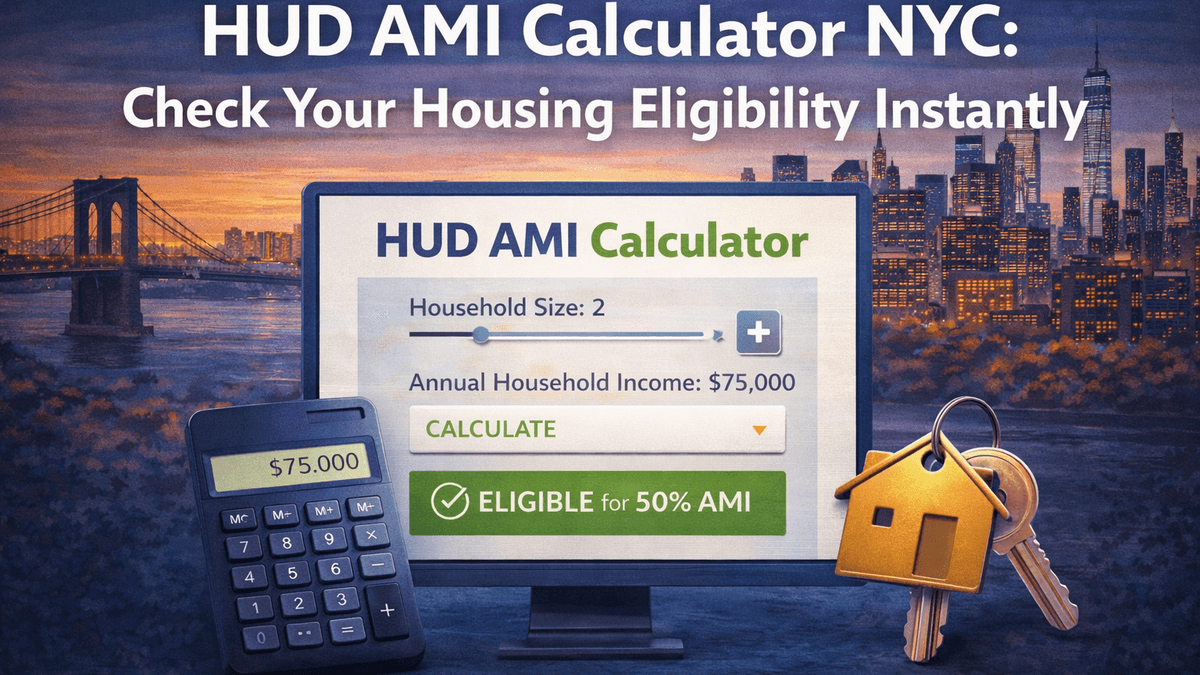
Use the free HUD AMI calculator to instantly check your NYC affordable housing eligibility based on household size and income.
What Is the HUD AMI Calculator?
The HUD AMI Calculator is a tool that determines whether your household income falls within the eligibility range for affordable housing programs based on HUD's official income limits.
Key Functions:
- Calculates your AMI percentage (30%, 50%, 60%, 80%, 100%, etc.)
- Compares your income to HUD's maximum limits for your household size
- Identifies which NYC Housing Connect lotteries you qualify for
- Projects rent affordability based on the 30% income rule
Data Source: The calculator uses HUD's annual income limits for the New York-Newark-Jersey City metropolitan statistical area (MSA), published every April.
Why HUD Income Limits Matter for NYC Housing
HUD income limits are federal law for:
- NYC Housing Connect lotteries (all affordable housing lottery applications)
- Section 8 Housing Choice Vouchers (rental assistance program)
- Low-Income Housing Tax Credit (LIHTC) developments (most new affordable buildings)
- Mitchell-Lama housing (middle-income affordable housing)
- Project-Based Section 8 (subsidized apartment buildings)
Without HUD compliance: Developers cannot receive federal funding or tax credits to build affordable housing.
How HUD Calculates NYC Income Limits
Step 1: Determine the Regional Median Income
HUD analyzes census data, wage surveys, and economic indicators to calculate the median household income for the New York-Newark metropolitan area.
For 2026: The median income for a family of three is approximately $121,500.
Step 2: Adjust for Household Size
HUD recognizes that larger households need more income than smaller ones to maintain the same standard of living.
Adjustment Factors:
- 1 person = 70% of family-of-four median
- 2 people = 80% of family-of-four median
- 3 people = 90% of family-of-four median
- 4 people = 100% (baseline)
- 5 people = 108% of family-of-four median
- 6 people = 116% of family-of-four median
- 7+ people = Additional 8% per person
Example:
- Median for 4 people: $135,000
- Median for 1 person: $135,000 × 0.70 = $94,500
- Median for 6 people: $135,000 × 1.16 = $156,600
Step 3: Calculate Percentage Bands
HUD creates income limits at various percentages of the adjusted median:
- 30% AMI (Extremely Low Income)
- 50% AMI (Very Low Income)
- 60% AMI (Low Income)
- 80% AMI (Low Income, also called "Section 8 limit")
- 100% AMI (Median Income)
- 120% AMI (Moderate Income)
- 130% AMI (Moderate Income)
- 165% AMI (Area Median – rare, for specific programs)
Example (2 people):
- Median for 2 people: $108,000
- 50% AMI: $108,000 × 0.50 = $54,000
- 60% AMI: $108,000 × 0.60 = $64,800
- 80% AMI: $108,000 × 0.80 = $86,400
Step 4: Publish Annual Updates
Every April, HUD releases updated income limits to account for:
- Inflation
- Wage growth
- Changes in regional median income
- Cost-of-living adjustments
Impact on NYC Housing: When HUD raises income limits, more households become eligible for affordable housing programs.
Using the NYC Housing Lottery AMI Calculator
Free Online AMI Calculator
The fastest way to check your eligibility is using the NYC AMI Calculator at nychousinglottery.com.
How to Use:
Step 1: Enter Your Household Size
- Count all adults and children who will live in the unit
- Include dependents (children, elderly parents, etc.)
Step 2: Enter Your Gross Annual Income
- Add up wages, salaries, self-employment income, benefits, and other sources
- Use gross income (before taxes and deductions)
- Include income from all adults in the household
Step 3: View Your Results
The calculator instantly shows:
- Your AMI percentage (e.g., "You are at 68% AMI")
- Which income bands you qualify for (e.g., "Eligible for 70%, 80%, 100% AMI lotteries")
- Estimated maximum rent you can afford (based on 30% income rule)
- Links to NYC Housing Connect listings matching your eligibility
Example Output:
Household Size: 3 people

Gross Annual Income: $75,000

✓ Your AMI Level: 72% AMI (between 60% and 80% AMI)


You qualify for:
✓ 70% AMI lotteries
✓ 80% AMI lotteries
✓ 100% AMI lotteries
✓ 120% AMI lotteries
✓ 130% AMI lotteries


You do NOT qualify for:
✗ 30% AMI lotteries (income too high)
✗ 40% AMI lotteries (income too high)
✗ 50% AMI lotteries (income too high)
✗ 60% AMI lotteries (income too high)


Estimated Maximum Rent: $1,875/month (30% of gross income)
Alternative: HUD's Official Income Limits Lookup
For manual verification, you can use HUD's official tool:
- Go to HUD User Income Limits
- Select New York State
- Find New York-Newark-Jersey City, NY-NJ-PA MSA
- View the PDF or Excel file with income limits by household size
Downside: HUD's tool requires manual interpretation. The NYC Housing Lottery AMI Calculator does this automatically.
What Your AMI Percentage Means for Housing Eligibility
Below 30% AMI (Extremely Low Income)
Income Example (2 people): Less than $32,400/year
Housing Options:
- ✓ Eligible for 30%–130% AMI lotteries
- ✓ Eligible for NYCHA public housing
- ✓ Eligible for Section 8 vouchers
- ✓ Eligible for homeless prevention programs
Challenge: Very limited lottery availability. Only 5–10% of units target 30% AMI.
30%–50% AMI (Very Low to Low Income)
Income Example (2 people): $32,400–$54,000/year
Housing Options:
- ✓ Eligible for 40%–130% AMI lotteries
- ✓ Eligible for Section 8 vouchers
- ✓ Eligible for supportive housing programs
Challenge: High demand. 40%–50% AMI lotteries receive thousands of applications per unit.
50%–60% AMI (Low Income – Most Common)
Income Example (2 people): $54,000–$64,800/year
Housing Options:
- ✓ Eligible for 60%–130% AMI lotteries
- ✗ NOT eligible for 30%–50% AMI lotteries (income too high)
Advantage: 40–50% of NYC Housing Connect lotteries target 60% AMI. Most options are here.
60%–80% AMI (Low to Moderate Income)
Income Example (2 people): $64,800–$86,400/year
Housing Options:
- ✓ Eligible for 70%–130% AMI lotteries
- ✗ NOT eligible for 30%–60% AMI lotteries (income too high)
Advantage: Moderate competition. Teachers, nurses, and city workers often fall in this range.
80%–100% AMI (Moderate to Median Income)
Income Example (2 people): $86,400–$108,000/year
Housing Options:
- ✓ Eligible for 80%–130% AMI lotteries
- ✗ NOT eligible for 30%–70% AMI lotteries (income too high)
Challenge: Only 15–20% of lotteries target this band. Market-rate might be a better option.
100%+ AMI (Above Median Income)
Income Example (2 people): Over $108,000/year
Housing Options:
- ✓ Eligible for 100%–130% AMI lotteries (rare)
- ✗ NOT eligible for 30%–80% AMI lotteries (income too high)
Reality: Very few lotteries target above-median income households. Consider market-rate housing.
Common HUD AMI Calculator Questions
What Income Sources Does HUD Count?
HUD includes all income from all household members:
Included:
- ✓ Wages and salaries
- ✓ Self-employment income
- ✓ Social Security benefits
- ✓ Unemployment benefits
- ✓ Workers' compensation
- ✓ Child support and alimony
- ✓ Pension and retirement income
- ✓ Investment income (interest, dividends, capital gains)
- ✓ VA benefits
- ✓ SSI (Supplemental Security Income)
- ✓ Rental income from properties you own
Excluded:
- ✗ Income earned by children under 18
- ✗ One-time gifts or inheritances (but recurring trust income counts)
- ✗ Student financial aid (grants, scholarships, loans)
- ✗ Foster care payments
- ✗ Tax refunds
Critical: HUD uses gross income (before taxes), not net income (after taxes).
Can I Exclude Deductions Like Retirement Contributions?
No. HUD calculates income before deductions for:
- 401(k) or IRA contributions
- Health insurance premiums
- Union dues
- Commuter benefits
- HSA contributions
Example:
- Gross salary: $70,000
- 401(k) contribution: $5,000
- Health insurance: $3,000
- HUD counts: $70,000 (not $62,000)
What If My Income Changed Recently?
HUD uses current income, not last year's tax return.
Scenario 1: Income Increased
- Last year's tax return: $60,000
- Current income: $75,000
- Use: $75,000 (current, not historical)
Scenario 2: Income Decreased
- Last year's tax return: $80,000
- Current income: $65,000 (due to job loss or reduced hours)
- Use: $65,000 (current, not historical)
Documentation: Be prepared to explain income changes with:
- Pay stubs showing current salary
- Employer letter confirming new wage
- Unemployment benefit statements (if applicable)
How Often Should I Recalculate My AMI?
Recalculate when:
- You get a raise or promotion
- You lose a job or reduce hours
- A household member starts or stops working
- You receive a new income source (inheritance, side business, etc.)
- HUD releases new income limits (every April)
Why It Matters: Your AMI percentage determines which lotteries you qualify for. If your income rises above the limit, you'll be disqualified—even after being selected.
HUD AMI Calculator vs. NYC Housing Connect Filters
Using the Calculator Before Browsing
Best Practice:
- Calculate your AMI percentage first
- Then browse NYC Housing Connect with filters set to your eligible bands
Why? Browsing without knowing your AMI wastes time. You'll see lotteries you don't qualify for.
Filtering NYC Housing Connect by Income
After calculating your AMI:
- Go to housingconnect.nyc.gov
- Click "Current Listings"
- Filter by:
- Borough: Your preference
- Income Band: Your AMI percentage (e.g., "60% AMI")
- Bedroom Count: Based on household size
Result: You'll only see lotteries you're eligible for.
Pro Tip: Set up automated alerts at NYC Housing Lottery Alerts to get notified when new lotteries matching your AMI band and preferences are posted.
HUD Income Limits vs. Rent Calculations
The 30% Income Rule
HUD recommends that rent should not exceed 30% of gross household income.
Formula:
Maximum Affordable Rent = (Gross Annual Income × 0.30) ÷ 12
Example (2 people, 60% AMI):
- Gross annual income: $64,800
- Gross monthly income: $64,800 ÷ 12 = $5,400
- Maximum affordable rent: $5,400 × 0.30 = $1,620/month
Reality: Many NYC households pay 40%–50% of income on rent. Affordable housing programs aim to reduce this burden to 30%.
Minimum Income Requirements
Some lotteries also set minimum income requirements to ensure applicants can afford the rent.
Formula:
Minimum Income = Monthly Rent × 12 ÷ 0.30
Example:
- Rent: $1,500/month
- Minimum income: ($1,500 × 12) ÷ 0.30 = $60,000/year
Why It Matters: You must earn both:
- ✓ Enough to afford the rent (minimum income)
- ✓ Not too much to exceed the AMI cap (maximum income)
This creates a narrow eligibility window.
Using HUD AMI Calculator for Strategic Applications
Strategy 1: Apply to the Highest AMI Band You Qualify For
Why? Lower AMI lotteries (30%–60% AMI) receive more applications than higher bands (80%–100% AMI).
Example:
- Your AMI: 72%
- You qualify for: 70%, 80%, 100%, 120% AMI lotteries
- Apply to: 80% AMI first (less competition than 70%)
Strategy 2: Target Mixed-Income Developments
Some buildings offer units at multiple AMI levels (e.g., 40%, 60%, 80% in the same building).
Advantage: If you qualify for 80% AMI, you can apply to the 80% AMI units without competing against 40% and 60% AMI applicants.
Strategy 3: Monitor for Income Limit Increases
When HUD raises income limits in April:
- Households near the cutoff become newly eligible
- Apply immediately to beat the rush
Example:
- 2025: 60% AMI for 2 people = $62,500 (you earn $63,000 — ineligible)
- 2026: 60% AMI for 2 people = $64,800 (you earn $63,000 — now eligible!)
Action: Recalculate your AMI every April when HUD releases new limits.
Frequently Asked Questions
What is a HUD AMI calculator?
A HUD AMI calculator determines your Area Median Income percentage based on your household size and gross annual income using HUD's official income limits. It tells you which affordable housing programs you qualify for.
How do I calculate my AMI for NYC housing?
Divide your household's gross annual income by HUD's income limit for your household size at a given AMI percentage. Use the NYC AMI Calculator for instant, accurate results.
What is the income limit for NYC Housing Connect?
It depends on the lottery. Most target 50%–80% AMI. For a household of two, 60% AMI is $64,800 in 2026. Check each listing for specific limits.
Does HUD count unemployment benefits as income?
Yes. HUD counts unemployment benefits, Social Security, SSI, child support, alimony, and all other income sources except student aid and income earned by children under 18.
What if my income is between two AMI bands?
Apply to lotteries at or above your income level. If you're at 72% AMI, apply to 70%, 80%, 100%, and 120% AMI lotteries—but not 60% AMI (you're over the limit).
Can I use last year's income for AMI calculations?
No. HUD requires current income. If your income changed since your last tax return, use your current earnings and be prepared to document the change.
How often does HUD update NYC income limits?
HUD updates income limits every April. Check the NYC AMI Calculator or HUD's website for the latest figures.
What happens if I'm $1 over the AMI limit?
You're disqualified. Even being $1 over the maximum income for your household size results in automatic rejection.
Conclusion
The HUD AMI calculator is your most important tool for navigating NYC's affordable housing lottery system. By understanding your exact AMI percentage and using it to filter eligible lotteries, you'll save time, avoid disqualifications, and maximize your chances of securing an affordable apartment.
Use the calculator every time your income changes, whenever HUD releases new limits, and before applying to any lottery. Combined with automated alert services, this strategic approach gives you the best possible odds in NYC's competitive affordable housing market.
Internal Links:
- NYC AMI Calculator
- Complete 2026 NYC AMI Chart
- NYC Income Limits Guide
- Sign Up for NYC Housing Lottery Alerts
- Complete NYC Housing Lottery Guide
- NYC Housing Lottery FAQ
External Resources: